


Home of Cards: Cozy Solitaire
Steamroller Games
Home of Cards: Cozy Solitaire is the kind of card game I open when I want something calm, familiar, and easy to leave after a few minutes. Its central appeal is simple: Tripeaks Solitaire gives me a light puzzle to solve, while the surrounding home-design theme gives each completed hand a sense of progress beyond merely clearing cards. That combination makes it more inviting than a plain solitaire deck, although it also means the experience may not satisfy players who want deep strategy or a completely distraction-free card table.
After spending time with it, my view is clear: this is best treated as a relaxing daily game rather than a serious solitaire challenge. The free entry point helps, and the Everyone age rating makes it approachable for a broad audience. Still, the design-and-decoration layer will matter a lot to your enjoyment. If you like gradually shaping a cozy space, it adds motivation. If you only want fast card rounds with no extra objectives, traditional solitaire apps may suit you better.
How the Tripeaks format works in practice
Tripeaks Solitaire is easy to understand but not entirely automatic. Cards are arranged in three peaks, and I remove exposed cards by choosing one rank above or below the current card. The basic rule is familiar enough for casual players to grasp quickly, yet each choice can affect what becomes available next. That gives the game a pleasant middle ground: I do not need to study a rulebook, but I still have reasons to pause before tapping.
The strongest moments come from building a run. When several playable cards appear in sequence, clearing them together feels more satisfying than taking isolated moves. I found that the best decisions were often less obvious than simply choosing the first available card. Sometimes preserving a possible continuation is more valuable than making an immediate match, especially when several face-down cards are waiting to be uncovered.
This is where the game works better than a purely decorative card title. The home theme may be the visible reason to continue, but the card layout supplies the moment-to-moment interest. A round can begin almost absent-mindedly and then become a small exercise in planning. I would not call the strategy demanding, but it is enough to stop the game from feeling like a sequence of meaningless taps.
Related News






There is also a useful rhythm to the format. A short round fits naturally into a coffee break, a commute when I am seated, or the few minutes before bed. I can play without committing to a long session, and the low-pressure presentation makes it easy to stop after one hand. That flexibility is one of the title’s most practical strengths.
Why the home-building layer matters
The decoration element gives successful card rounds a visible purpose. Instead of treating every win as an isolated result, the game connects progress to the idea of improving a personal space. I found that this changed how I approached repeated rounds. In a standard solitaire app, I might play until the novelty fades. Here, the promise of another small improvement gives the session a clearer direction.
That does not turn the game into a full interior-design simulator. The cards remain the main activity, and the home theme works as a reward structure rather than a replacement for the puzzle. This distinction is important for expectations. Anyone downloading it for detailed decorating tools could be disappointed, while someone looking for a gentle reason to keep playing solitaire will probably understand the balance immediately.
Gallery
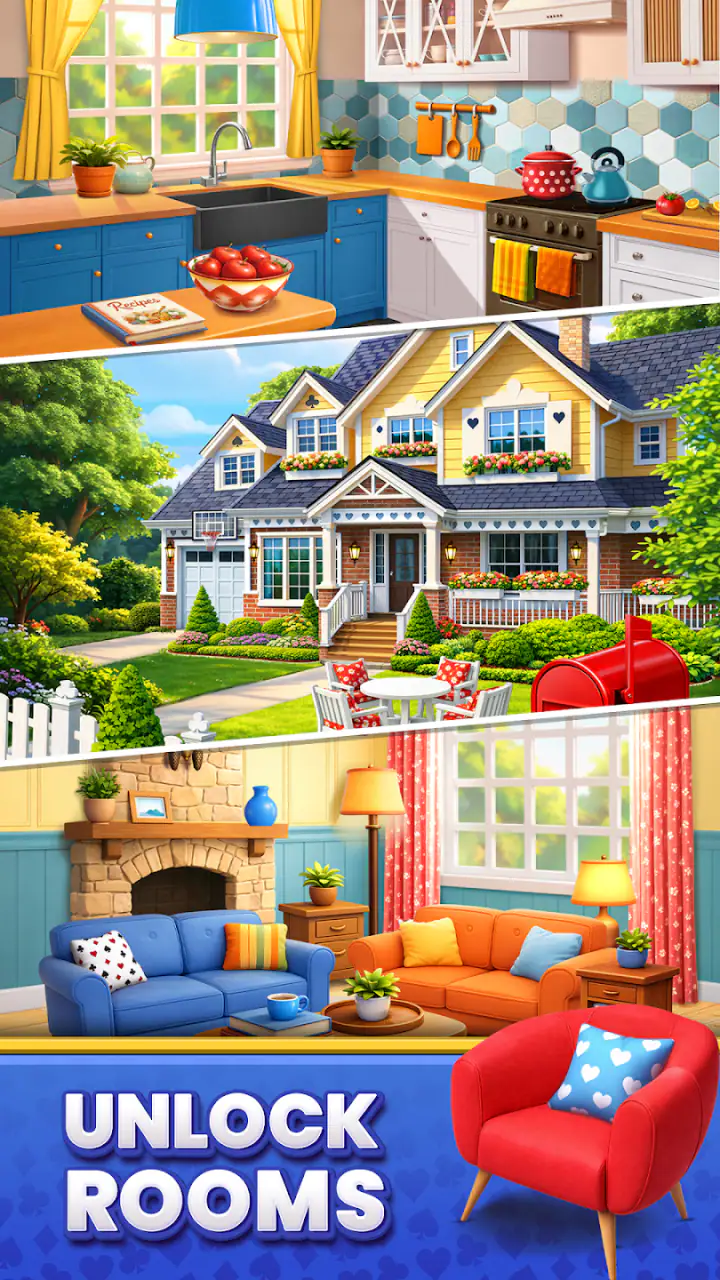
My practical tip is to think of the decorating progress as a pacing tool, not as a demand to play continuously. The game is more enjoyable when I use the next home improvement as a pleasant milestone. Chasing it too aggressively can make the card rounds feel repetitive, particularly if I am already tired of the Tripeaks pattern.
Small decisions that improve a round
The most useful habit I developed was looking beyond the currently available move. Before clearing a card, I tried to identify which face-down group it might expose and whether the move could extend a run. This is a modest form of planning, but it makes a noticeable difference in how engaged I feel. The game remains accessible while rewarding players who resist tapping on impulse.
A second tip is to value flexibility. If two cards are available, I usually prefer the move that leaves more possible follow-up ranks rather than the one that only works immediately. This is especially helpful when the layout offers several peaks and I need to decide which area to open first. The game does not require advanced probability calculations, but it does reward keeping options alive.
I also recommend treating a failed round as information rather than a reason to rush into purchases. A loss can reveal that I committed to one sequence too early or ignored another exposed card. Taking a moment to review the choices makes the next attempt more satisfying. That approach is particularly important in a free game with optional in-app purchases, because patience is often a better first response than spending.
Progress, pacing, and the free-to-play question
The game is free to download and play, which makes it easy to test without making a commitment. Its optional purchases range from $0.99 to $99.99 per item, so the possible spending spectrum is broad. I would advise setting a personal limit before playing, especially if the home-progress loop makes you want to move forward faster than the cards naturally allow.
For me, the free structure is most comfortable when I accept the game’s slower rhythm. The attraction is supposed to come from playing hands, making decisions, and gradually seeing progress. If I start treating every delay as something to overcome immediately, the relaxing quality weakens. The title works best when purchases remain optional conveniences rather than part of the basic expectation.
One meaningful trade-off is therefore control over pace. Players who enjoy earning progress slowly may find the structure motivating, because each session contributes to a longer project. Players who want to unlock every visual element quickly may feel friction. I would not recommend approaching this as a race. It is much better as a small routine that rewards consistency.
The version I reviewed is 1.48.2, and the game requires Android 6.0 or later. That makes it accessible on many older Android devices, although actual comfort will still depend on the phone’s general condition and screen responsiveness. The developer is Steamroller Games, and the title has built a strong audience, with over 100 thousand installs and a 4.7 average from around 3.3 thousand ratings.
Those numbers suggest that the combination of solitaire and home decoration has found a receptive audience, but they should not be mistaken for proof that every solitaire fan will enjoy it. The appeal is specific. It depends on liking a relaxed progression loop as much as liking the card rules themselves. I would pay more attention to that fit than to popularity alone.
Where it feels stronger than ordinary solitaire
Compared with a conventional solitaire app that focuses almost entirely on card handling, Home of Cards: Cozy Solitaire has a clearer emotional hook. A plain game may be cleaner and more efficient, but it can also feel interchangeable. Here, the home theme gives repeated rounds a bit of personality and makes progress easier to notice.
It is also more welcoming for someone who does not already have a strong attachment to solitaire. A friend who finds standard card tables dull may be more willing to try a round when there is a broader cozy objective attached. That makes it a good shared recommendation for casual players, older family members, or anyone who wants a low-pressure game without learning a complicated new system.
On the other hand, a minimalist solitaire app can be the better choice when I want pure concentration. The extra theme adds context, but it also adds another layer to think about. Players who prefer quick card solving with no progression framing may find the home element unnecessary. Neither approach is universally superior; they serve different moods.
The limitation I noticed most
The central weakness is repetition. Tripeaks is approachable because its rules are straightforward, but that same simplicity can become predictable during longer sessions. The decorating objective helps, yet it cannot completely change the underlying card loop. After several rounds, I sometimes felt that I was playing mainly to reach the next progression step rather than because each hand was fresh.
That is why I would not recommend marathon sessions. The game is at its best in short visits, where the familiar pattern feels soothing instead of routine. If you prefer games with constantly changing mechanics, a stronger narrative, or more demanding tactical variety, this will probably feel too gentle. The title knows what it wants to be, but it does not try to solve every kind of gaming preference.
There is another small point to consider: the home theme can create a mismatch between the promise of customization and the reality of a card-first experience. I enjoyed having a visual reason to continue, but anyone expecting detailed control over every part of a room should keep expectations modest. The design layer supports the solitaire rather than competing with it for control.
The age rating is Everyone, which fits the approachable rules and relaxed presentation. I can see it working well as a casual family-friendly option, provided the person playing understands that optional purchases are present. For younger players, I would still use the usual device-level spending safeguards, not because the game is inherently difficult, but because the broad purchase range makes boundaries sensible.
Who should play it and who should skip it
I think this is a strong fit for people who enjoy card games as a way to unwind. If you like solitaire but want a little more purpose than a win counter, the home-progress idea gives each session a gentle sense of direction. It is also a good choice for players who prefer short activities that can be paused without losing the whole evening.
It suits a very specific everyday scenario: I can imagine opening it after dinner while waiting for tea to cool, playing one or two hands, and stopping once the next small objective is complete. The session does not need a dramatic conclusion. That quiet, repeatable routine is exactly where the game feels most natural.
It is less suitable for competitive players. There is no reason in the core concept to expect the intensity of a ranked card game, and the home theme shifts attention away from head-to-head pressure. If your ideal card experience involves opponents, bluffing, leaderboards, or complex deck construction, you should look elsewhere.
I would also steer away players who dislike free-to-play pacing in principle. Even when I do not spend, the existence of optional purchases can affect how I view progress. Some people are perfectly comfortable ignoring them; others find their presence distracting. Knowing which group you belong to is more useful than assuming the free download automatically means a completely frictionless experience.
For someone new to Tripeaks, I recommend beginning with a patient mindset. Do not judge the game by the first few taps. The interesting part is learning to preserve sequences and choose the order of exposed cards. Once that small layer of planning becomes familiar, the rounds feel less like luck and more like manageable puzzles.
For experienced solitaire players, the question is different: do you want atmosphere and progression, or do you want maximum purity? If you want a clean, endlessly repeatable card exercise, a traditional solitaire alternative may be more satisfying. If you enjoy having a visual project alongside the cards, this title offers a warmer reason to return.
My verdict after living with the game
Home of Cards: Cozy Solitaire succeeds because it understands the value of a modest goal. It does not need complicated rules to make a short break enjoyable. Tripeaks supplies accessible decisions, while the home theme gives those decisions a sense of continuity. I especially liked the way a simple run of cards could feel meaningful when it helped move the broader project forward.
My reservations are just as clear. The card loop can become repetitive, the decoration layer may feel lighter than some players expect, and the optional purchase range means I would approach the progression system with a budget in mind. These are not deal-breakers for the right audience, but they are important reasons not to recommend it as a universal solitaire replacement.
My recommendation is to try it if you want calm, casual card sessions with a cozy progression goal. Play in short bursts, look for moves that preserve future options, and let the home improvements arrive at their own pace. If that sounds more appealing than a bare card table, Steamroller Games has made a friendly and approachable choice.
If your priority is demanding strategy, competitive play, or a completely uncluttered solitaire experience, I would choose another option instead. For everyone else, the free starting point makes the decision easy: give it a few relaxed rounds and see whether the combination of Tripeaks and home-building gives your downtime the extra bit of purpose you have been missing.
Home of Cards: Cozy Solitaire is not trying to reinvent card games, and that is part of its charm. It takes a familiar format, adds a gentle visual destination, and turns it into a comfortable habit. I would keep it installed for those moments when I want something welcoming rather than demanding, as long as I remember that its best feature is its relaxed rhythm—not endless variety.
FAQs for Home of Cards: Cozy Solitaire
What is Home of Cards: Cozy Solitaire?
Home of Cards: Cozy Solitaire is a relaxing mobile card game built around classic solitaire-style gameplay. Alongside completing card layouts, players can enjoy a cozy home-design experience, gradually decorating and improving rooms as they progress. Its gentle presentation, simple controls, and unhurried pace make it suitable for players looking for a casual game rather than a competitive or highly demanding card challenge.
How does the gameplay work in Home of Cards: Cozy Solitaire?
The main gameplay follows familiar solitaire mechanics, with players arranging cards according to the rules of the selected layout and attempting to clear the board. Successful rounds generally reward progress or resources that can be used within the home-decoration portion of the game. The controls are designed for touchscreens, so cards can typically be tapped or dragged, making the experience accessible even for people who do not regularly play card games.
Is Home of Cards: Cozy Solitaire free to download and play?
Home of Cards: Cozy Solitaire can generally be downloaded without an upfront purchase, but the free version may include optional in-app purchases and advertising. These extras can provide additional resources, bonuses, or convenience, although they are not necessarily required to enjoy the basic solitaire experience. Before downloading, users should check the current store listing for the exact purchase options, advertising policy, and any regional differences.
Can Home of Cards: Cozy Solitaire be played offline?
Some solitaire rounds may remain playable without a constant internet connection, which can make Home of Cards: Cozy Solitaire convenient for short sessions while traveling or when mobile data is unavailable. However, features such as advertisements, purchases, cloud synchronization, events, updates, or online rewards may require connectivity. Because offline availability can change between versions, it is best to test the game after installation rather than assume every feature works without internet access.
Is Home of Cards: Cozy Solitaire suitable for all ages?
The game is generally easy to understand and does not rely on complex controls, making it approachable for many casual players. Its card puzzles and decorating mechanics are usually more suitable for users who enjoy relaxed, repetitive gameplay. Parents should still review the app’s age rating, advertising, privacy information, and in-app purchase settings before allowing children to play, especially if the device is linked to a payment method.
Pros
- Relaxing solitaire gameplay suited to short or extended sessions.
- Cozy visual design creates a calm
- welcoming atmosphere.
- Simple controls make it accessible for casual players.
- Card challenges offer a pleasant break from more demanding games.
- Progression and collection elements add motivation beyond each round.
Cons
- Some content or features may require in-app purchases.
- Gameplay can feel repetitive after extended play sessions.
- Limited interaction may disappoint players seeking deeper strategy.
- Ads may interrupt the experience for users on the free version.
- Performance and battery use can vary across older devices.


